

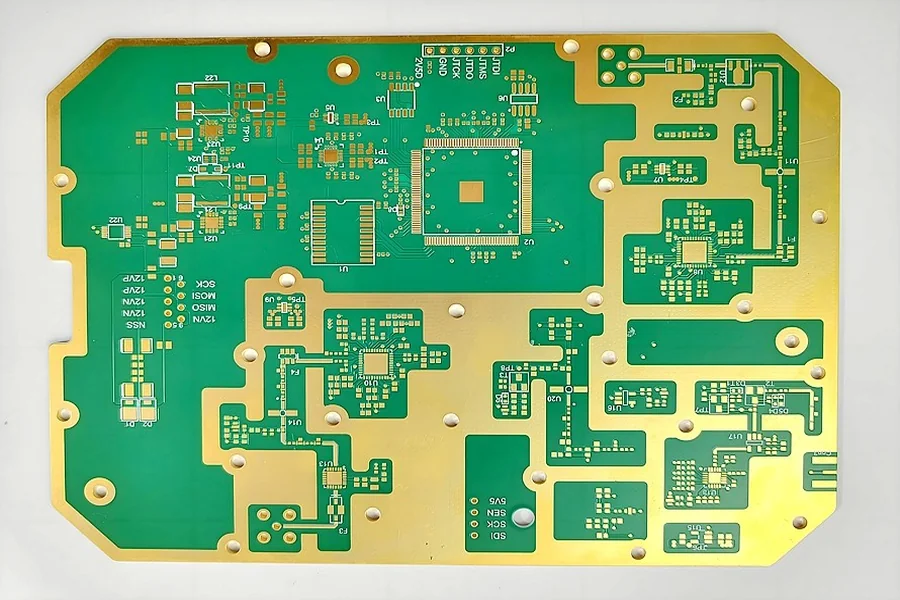
A Rogers Printed Circuit Board is a high-performance PCB made using laminates from Rogers Corporation, a leading manufacturer of advanced circuit materials. Unlike standard FR4 boards, Rogers PCBs are designed to deliver exceptional electrical, thermal, and mechanical properties, making them ideal for high-frequency and high-speed applications. Their unique composition ensures minimal signal loss, excellent dimensional stability, and superior performance in demanding environments.
What Makes Rogers Printed Circuit Board Different?
The key difference between a Rogers PCB and a traditional PCB lies in the dielectric material. Rogers laminates, such as RO4000, RO3000, and RT/duroid® series, offer:
- Low Dielectric Constant (Dk) with excellent stability across frequencies.
- Low Loss Tangent, resulting in minimal signal attenuation.
- Superior Thermal Management for applications involving high power or heat.
- Moisture Resistance, ensuring reliable operation even in humid or harsh conditions.
These properties make Rogers PCBs a preferred choice for industries that cannot compromise on performance, such as aerospace, telecommunications, and defense.
Advantages of Rogers Printed Circuit Board
- High-Frequency Performance – Rogers laminates maintain consistent performance at frequencies exceeding 10 GHz, which is critical for RF and microwave applications.
- Thermal Stability – Low coefficient of thermal expansion (CTE) ensures the PCB remains dimensionally stable even during rapid temperature changes.
- Signal Integrity – Exceptional electrical properties prevent distortion, ensuring precise data transmission.
- Long-Term Reliability – High resistance to environmental factors extends the operational lifespan of the PCB.
Common Applications of Rogers Printed Circuit Boards
Due to their outstanding performance, Rogers PCBs are widely used in:
- 5G Communication Systems for stable, high-speed connectivity.
- Radar and Satellite Systems where signal clarity is crucial.
- Aerospace and Defense Electronics requiring lightweight yet durable boards.
- Medical Imaging Equipment like MRI and CT scanners.
- Automotive Advanced Driver-Assistance Systems (ADAS) for safety-critical functions.
Manufacturing Challenges and Considerations
Fabricating a Rogers PCB requires specialized skills and equipment. Unlike FR4, Rogers materials demand precise drilling, controlled lamination, and accurate impedance control. Improper handling can lead to defects, performance degradation, or increased costs. Therefore, selecting the right fabrication partner is critical to achieving the desired performance.
The Growing Demand for Rogers PCBs
With the rise of 5G, autonomous vehicles, and space exploration technologies, the demand for high-frequency, high-reliability PCBs is rapidly increasing. Rogers PCBs are positioned as one of the best solutions for meeting these advanced requirements, and their role in next-generation electronics will only continue to expand.
Choosing the Right Manufacturing Partner
Producing a Rogers Printed Circuit Board involves advanced techniques, strict material handling, and precise quality control. To ensure optimal results, it’s essential to work with an experienced Rogers PCB manufacturer who understands the material’s unique properties and application requirements. A skilled manufacturer can help you achieve the best possible performance, minimize manufacturing risks, and deliver boards that meet industry standards for reliability and efficiency.
